

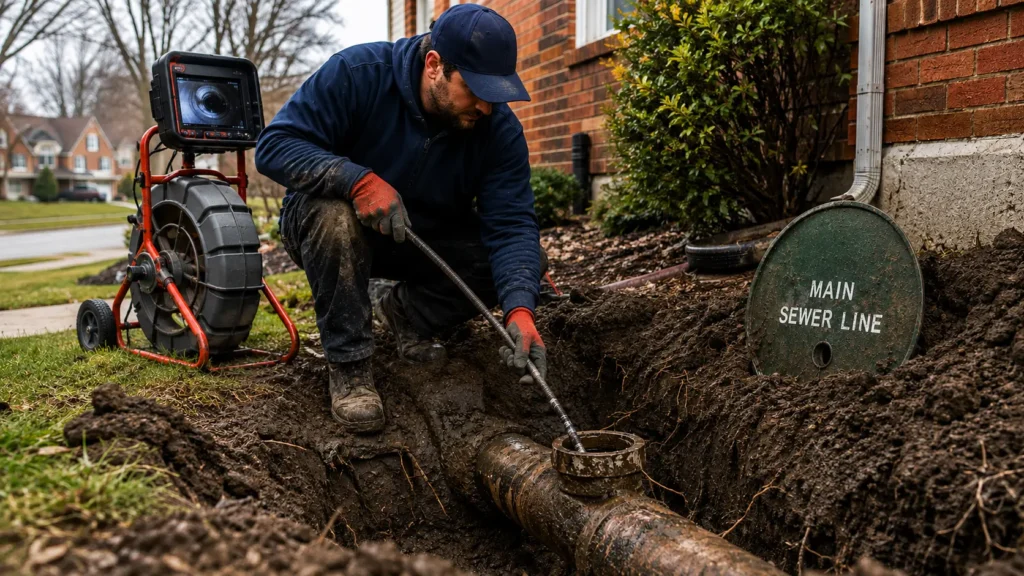
It usually starts small. The kitchen sink drains a little slower than usual, so you run some hot water and forget about it. A few days later, the toilet gurgles when the washing machine empties, then the basement floor drain starts backing up during a load of laundry, and you’re left wondering whether these problems are connected.
That question matters, because the answer changes how the problem should be fixed. A single slow fixture is often a local clog in one branch line. Several fixtures acting up together point elsewhere: the main sewer line that carries wastewater from your entire home to the municipal system. Learning to tell the difference is the first step toward solving a main sewer line clog in Toronto instead of chasing symptoms fixture by fixture.
This guide walks through the signs, causes, and practical steps Toronto homeowners can take when the problem looks bigger than one drain.
What Is the Main Sewer Line?
Every fixture in your home sinks, toilets, tubs, the washing machine, and the basement floor drain connects to a branch drain. Those branch drains lead into one larger pipe running beneath the basement floor and out to the property line. That larger pipe is the main sewer line, sometimes called the sewer lateral.
Think of it like a tree: each fixture is a small branch, several branches join into a bigger limb, and everything flows into the trunk. If a branch is blocked, only that fixture is affected. If the trunk is blocked, everything upstream backs up, which is why several fixtures acting up together is such a strong clue.
Main Drain vs. Main Sewer Line
Homeowners often use “main drain” and “main sewer line” interchangeably, and that’s fine in most conversations. Technically, the main drain is the larger pipe inside the home where branch lines converge, while the main sewer line is the continuation of that pipe once it leaves the house and travels underground to the municipal connection.
In Toronto, this pipe is split into two sections with different owners. According to the City of Toronto, the sewers on the street line running from the property line into the home belongs to the homeowner, while the section running from the property line to the sewer main under the street belongs to the City. That distinction matters, since it affects who gets called first when a main sewer line clog in Toronto is suspected.
7 Signs You May Have a Main Sewer Line Clog in Toronto
Not every clog announces itself the same way. These are the signs Toronto plumbers see most often when the issue turns out to be farther downstream than a single fixture.
1. Multiple Drains Are Slow at the Same Time
One slow sink is usually isolated. But when the kitchen sink, a bathroom drain, and the tub all start draining sluggishly in the same week, wastewater is likely struggling to leave the house at all a common early pattern behind a main sewer line clog in Toronto.
2. Toilets Gurgle When Other Fixtures Drain
A toilet that gurgles right after you run the washing machine or flush a different toilet is telling you something: air is being pushed backwards through the plumbing because water further down the line has nowhere else to go. It’s one of the more reliable early indicators of a main sewer line clog in Toronto, especially when it happens consistently.
3. Water Backs Up Into a Basement Floor Drain
Basement floor drains sit at the lowest point in most Toronto homes, so they’re often the first to reveal a downstream blockage. If water, or worse, sewage, rises out of that drain when you run water elsewhere, the restriction is likely beyond that point, closer to or inside the main line.
4. One Fixture Is Not the Only Problem
A single blocked sink rarely needs the same response as several fixtures backing up together.
|
Symptom |
More Likely Cause |
| One sink is blocked |
Local drain clog |
|
One shower drains slowly |
Shower/branch drain issue |
| Several fixtures are slow |
Possible main sewer restriction |
|
Multiple fixtures back up |
Possible main sewer line problem |
| Basement drain backs up |
Possible downstream blockage |
5. Sewage Odours Keep Returning
A sewer smell on its own doesn’t automatically mean a main sewer line clog in Toronto; it can come from a dry P-trap or a loose vent connection. But when the smell keeps returning alongside slow drains or gurgling, it’s worth taking seriously rather than masking with air freshener.
6. The Problem Keeps Coming Back After Drain Cleaning
If a drain clears up after cleaning but the slowness returns within weeks, something is regenerating the blockage. Tree roots, pipe damage, grease buildup, and separated joints can all make a pipe look clear temporarily, then fail again; usually, this is the point where a camera inspection in Toronto becomes the most useful next step.
7. Water Backs Up When the Washing Machine Runs
Washing machines discharge water faster than most fixtures. That surge can expose a partial restriction slower-draining fixtures haven’t yet revealed. If a laundry cycle reliably triggers backup elsewhere in the house, that volume is doing the diagnostic work for you.
How to Tell a Main Sewer Line Clog From a Single Drain Clog
Once you’ve noticed one or more of the signs above, compare the overall pattern rather than fixating on a single symptom.
Signs of a Localised Drain Clog
- Only one fixture is affected
- Every other drain works normally
- The problem stays isolated to one area, like a single bathroom
- Clearing that fixture restores normal drainage for good
Signs of a Main Sewer Line Problem
- Multiple fixtures are affected, not just one
- Toilets gurgle when other fixtures are used
- The basement drain backs up
- Water rises in one fixture when another one drains
- Blockages keep returning after being cleared
- Sewer odours persist despite cleaning
A Simple Rule of Thumb
One drain often means a local problem. Several drains mean it’s worth investigating farther downstream. Symptoms are a starting point, not a diagnosis; a main line issue can sometimes show through only one symptom early on. The pattern narrows down where to look, but confirming the exact location of a main sewer line clog in Toronto usually takes a proper inspection.
What Causes a Main Sewer Line Clog in Toronto?
Understanding the common causes explains why some blockages are harder to clear than others.
Tree Root Intrusion
Toronto has plenty of mature trees on residential streets, and roots seek out moisture. Where a sewer line has even a small crack or a separated joint, roots can work their way in and spread, restricting flow and causing a sewer pipe blockage.
Grease, Fat and Debris
Grease poured down a kitchen sink doesn’t stay liquid for long. It cools, sticks to the pipe wall, and narrows the passage over time. Letting it cool in a container and tossing it in the garbage prevents most of this buildup.
Wipes and Non-Flushable Materials
Even wipes labelled “flushable” don’t break down the way toilet paper does, and neither do paper towels or sanitary products. They catch on rough spots inside the pipe and contribute to a main sewer line blockage over time.
Cracked, Broken or Ageing Pipes
Many homes in and around Toronto have sewer lines that are decades old. Pipes can crack, break, or develop separated joints, and these weak points are also where roots and debris are most likely to catch.
Pipe Bellies or Low Spots
Ground settling can cause a section of pipe to sag slightly, creating a low spot known as a belly. Water still flows through, but solids and debris tend to collect there instead of moving along with it.
Can You Unclog a Main Sewer Line Yourself?
For a genuinely isolated fixture clog, a plunger or a simple hand auger is often a reasonable first step. A main sewer line clog in Toronto is a different matter. Chemical drain cleaners aren’t a reliable fix here; they’re built for smaller, accessible pipes, and pouring large amounts into a main line rarely clears a deeper blockage; the standing chemical can just sit and complicate matters for anyone who works on it later.
If a backup already seems underway, cut back on water use and hold off on laundry, dishwashing, and long showers until it’s assessed. Repeatedly flushing toilets during an active backup can make things worse.
When DIY Drain Clearing May Be Reasonable
- A single fixture is affected, and nothing else in the house is
- The clog clears with a plunger or basic auger and doesn’t return
- There’s no gurgling, odour, or backup at other drains
When It Is Time for Professional Diagnosis
- Multiple drains are affected at once
- Sewage is actively backing up
- The same problem keeps returning after cleaning
- A basement floor drain is involved
- Roots or pipe damage are a realistic possibility
How a Camera Inspection in Toronto Can Find the Problem
When a blockage keeps coming back, or the cause isn’t obvious, a camera inspection in Toronto is usually the most direct way to find out what’s happening inside the pipe rather than guessing from symptoms alone.
The process is straightforward:
- A plumber identifies an access point, often a cleanout or accessible fixture.
- A waterproof inspection camera is inserted into the line.
- The camera is guided through the pipe at a controlled pace.
- The technician views a live feed of the inside of the pipe.
- Any problem area is identified and its location noted.
- That information determines the appropriate next step.
A camera inspection can reveal tree roots, heavy buildup, cracks, broken sections, separated joints, collapsed pipe, and points where blockages keep forming. It won’t answer every plumbing question on its own, but for a suspected main sewer line clog in Toronto, it removes most of the guesswork. Our camera inspection in Toronto guide covers more signs worth watching for.
When Does a Main Sewer Line Clog Need Drain Repair in Toronto?
Not every blockage means the pipe needs to be replaced. What kind of drain repair in Toronto is appropriate depends entirely on what an inspection actually finds.
Drain Cleaning or Main Line Clearing
When the pipe is structurally sound and the issue is removable buildup, thorough drain cleaning or main line clearing may be all that’s needed.
Root Removal
When roots are restricting the pipe, they can often be cut out and cleared without replacing the section, provided the pipe itself isn’t significantly damaged.
Spot Repair
If an inspection shows one isolated section of damage, a spot repair targeting just that section can resolve the issue without disturbing the rest of the line.
Sewer Line Replacement or Rehabilitation
For pipes that are severely damaged, collapsed, or deteriorated along a longer stretch, replacement or rehabilitation becomes the more durable option.
The correct repair depends on what is actually happening inside the pipe. No plumber should recommend a specific fix, especially a costly one, before confirming the cause.
What Toronto Homeowners Should Do During a Suspected Sewer Backup
Do:
- Reduce water use throughout the house
- Avoid unnecessary toilet flushing
- Keep children and pets away from any standing wastewater
- Contact a qualified plumbing professional
- Contact Toronto 311 if the issue may involve the municipal portion of the sewer line
Don’t:
- Keep running showers, dishwashers, or washing machines
- Pour large amounts of chemical drain cleaner into a suspected main-line blockage
- Assume temporary drainage means the problem is permanently resolved
- Ignore a backup that keeps happening
How Drain Expert Plumbing Diagnoses Main Sewer Problems
When Toronto homeowners call about repeated backups or several slow drains at once, Drain Expert Plumbing follows a straightforward diagnostic process rather than jumping straight to a fix.
Step 1: Understand the Symptoms. Which fixtures are affected, when it happens, and whether it’s tied to activities like laundry or heavy rain.
Step 2: Locate the Likely Problem Area. Determine whether the pattern looks localised to one fixture or points farther downstream toward the main line.
Step 3: Clear the Immediate Blockage When Appropriate. Restore drainage where it’s safe and practical to do so.
Step 4: Inspect the Line When Necessary. When a blockage is recurring or potentially structural, a camera inspection identifies the actual cause and location.
Step 5: Recommend the Appropriate Solution. That may mean drain cleaning, root removal, spot repair, or a larger repair, explained clearly before any work begins.
Frequently Asked Questions About Main Sewer Line Clogs in Toronto
1. How do I know if my main sewer line is clogged?
The clearest signs are multiple slow or backing-up drains at once, gurgling toilets, and backup at a basement floor drain. A single affected fixture is more often a local clog. When several signs appear together, a main sewer line clog in Toronto becomes more likely, though confirming it usually takes a closer look, like a camera inspection.
2. Can one clogged drain mean the main sewer line is blocked?
It’s possible, but less likely than when multiple fixtures are involved. Early on, only the lowest or most sensitive fixture, often a basement drain, may show symptoms first. If that one drain keeps acting up despite cleaning, it’s worth investigating further.
3. What is the most common sign of a main sewer line clog?
Multiple drains being slow or backing up at the same time is generally the most reliable early sign, especially paired with gurgling toilets. No single symptom confirms it alone, but this combination is the one Toronto plumbers see most consistently.
4. Can tree roots cause a main sewer line clog?
Yes. Roots are one of the most common causes of a main sewer line clog in Toronto, especially in older neighbourhoods with mature trees, since they can enter through small cracks or joints and grow to block the pipe.
5. Do I need a camera inspection before sewer line repair?
Not always, but it’s recommended whenever the cause isn’t obvious, the problem keeps returning, or a structural issue is suspected. A camera inspection confirms what’s happening inside the pipe rather than relying on guesswork, helping avoid paying for the wrong repair.
6. How much does main sewer line repair cost in Toronto?
No fixed number applies to every home. Cost depends on the cause, location, pipe condition, accessibility, repair method, and whether excavation is necessary. A professional assessment is the only reliable way to get an accurate estimate.
7. Who is responsible for a blocked sewer line in Toronto?
It depends on where the blockage sits. The City of Toronto maintains the portion of the sewer line from the property line to the municipal main under the street, while homeowners are responsible for the portion from the property line into the home. If the blockage is on the private side, repairs fall to the homeowner.
Don’t Ignore the Warning Signs of a Main Sewer Line Clog
One slow drain is usually nothing more than a local clog, and clearing it is often enough. But when several fixtures slow down together, toilets gurgle, the basement drain backs up, or the same blockage keeps returning, those signs deserve a closer look rather than repeated quick fixes. Catching a main sewer line clog in Toronto early and confirming it properly tends to be far less disruptive than dealing with a backup that’s already spreading through the house.
Dealing with recurring backups or several slow drains at once? Contact Drain Expert Plumbing to assess the problem and determine whether you need drain cleaning, camera inspection, or drain repair in Toronto.