

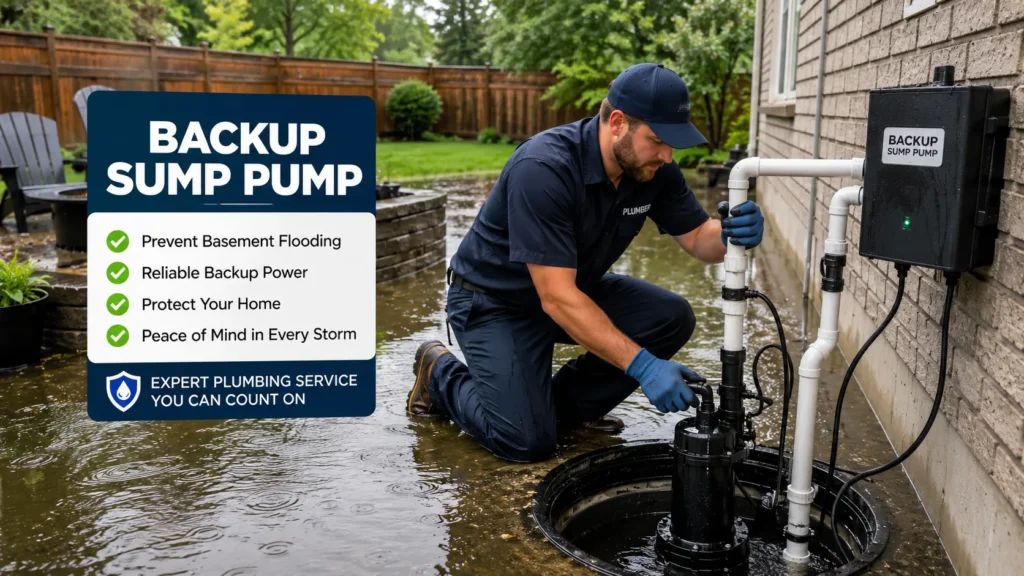
It’s 2 a.m., and the rain hasn’t let up in hours. A homeowner in the east end of Toronto stands at the top of their basement stairs, flashlight in hand, listening for their sump pump. The power has already flickered twice tonight. The pump has kept the basement dry for years, but tonight feels different, and they can’t shake the question: what happens if it stops working right now?
That scenario plays out across Toronto every storm season. A primary sump pump does the heavy lifting when it comes to keeping basements dry, but it isn’t invincible; it can fail from a power outage, a mechanical breakdown, or too much water coming in at once. That’s where the idea of a backup sump pump in Toronto comes in.
This article covers what a backup sump pump is, why Toronto’s weather and older housing stock make it worth considering, the different backup options available, and how to decide whether your home would genuinely benefit from one. We’ll also look at how a backup sump pump compares to a water valve backup in Toronto, since the two are often confused.
What Is a Backup Sump Pump?
A backup sump pump is a second pump, or a secondary power source for your existing pump, installed in the same sump pit as your primary system. Its job is simple: keep water moving out of the pit if the main pump can’t do it alone.
The primary sump pump service is your everyday workhorse, usually wired directly into your home’s electrical system to handle regular groundwater and rainfall. A backup system is there for the moments when the primary pump is compromised: a power failure during a storm, a mechanical jam, or a volume of water that exceeds what one pump can handle.
Homeowners typically add a backup system after a close call, after a previous flood, or after weighing what a wet basement would cost them in repairs and stress. It’s an extra layer of protection, not a replacement for basic maintenance or a working primary pump.
How Does a Backup Sump Pump Work?
The general process looks like this:
- Water drains into the sump pit through your home’s foundation drainage system or weeping tile.
- Under normal conditions, the primary sump pump activates and pushes that water out and away from the home.
- A backup system battery-powered, water-powered, or a second electric pump monitors conditions in the pit, often through a separate float switch.
- If the primary pump fails, loses power, or can’t keep pace with incoming water, the backup activates to take over, depending on how the specific system is set up.
Some backup systems run continuously alongside the primary pump for high-volume situations, while others sit dormant until they’re needed. The right setup depends on your pit, your pump, and your home’s water conditions.
Why Toronto Homes May Benefit From a Backup Sump Pump
Toronto’s climate and housing stock create a few conditions worth thinking about, even though every property is different.
- Heavy rainfall is a regular part of the city’s spring and summer months, and intense storms can drop a lot of water in a short period.
- Snowmelt in late winter adds another wave of moisture into the ground right as freeze-thaw cycles stress older foundations.
- Basement flooding has been a documented concern in several Toronto neighbourhoods, particularly those with older combined sewer systems or low-lying topography, and groundwater levels can vary block by block, which is part of why one house can stay bone-dry while the one next door struggles every spring.
Older homes are common across the city, and aging foundations and drainage systems don’t always perform the way they did when new. Combine that with severe weather events, which Environment Canada has noted are becoming more frequent in the region, and power interruptions during storms, and it’s easy to see why some homeowners choose backup protection.
None of this means every Toronto home needs a backup sump pump. It means these risk factors exist here more than in some other regions, and it’s worth understanding your own property’s situation rather than guessing.
7 Signs You May Need a Backup Sump Pump in Toronto
- Your basement has flooded before: Past flooding is one of the strongest predictors of future flooding. If water has gotten in once, the underlying conditions that caused it likely still exist.
- Your primary sump pump runs frequently: A pump cycling constantly during wet weather is dealing with a lot of water, and frequent operation means more wear, which raises the odds of a mechanical failure at the worst time.
- Your area experiences power outages: If your street tends to lose power during storms, your primary pump is vulnerable exactly when it’s needed most.
- Your current sump pump is old: Most sump pumps have a working lifespan, and components wear down over years of use. An aging pump is more likely to fail without warning.
- You have a finished basement: Flooring, drywall, furniture, and electronics all raise the financial stakes of a basement flood compared to an unfinished space.
- You travel frequently or leave the property unattended: A pump failure that goes unnoticed for a few hours is inconvenient. One that goes unnoticed for a week or two while you’re away can be a serious problem.
- You have never had your sump pump professionally inspected: Plenty of homeowners have a sump pump they’ve never had tested by a professional.
A proper diagnostic service can check the pump’s condition, the float switch, and the discharge line, giving you a clear picture of whether backup protection makes sense for your situation.
What Can Cause a Primary Sump Pump to Fail?
Power Failure
Standard sump pumps run on household electricity. When power goes out, often during the same storms that cause flooding risk in the first place, a pump without backup power simply stops working.
Mechanical Problems
Like any mechanical device, sump pumps wear out. Motors burn out, impellers get damaged, and seals degrade over time, especially with heavy use.
Float Switch Issues
The float switch tells the pump when to turn on. If it gets stuck, tangled, or worn out, the pump may not activate even though water is rising in the pit.
Blocked or Damaged Discharge Lines
The discharge line carries water away from your foundation. If it’s blocked by debris, frozen in winter, or damaged, water has nowhere to go even if the pump is working fine.
Too Much Water
Every pump has a maximum capacity. During an especially heavy storm, incoming water can exceed what a single pump is rated to handle, regardless of how well-maintained it is.
Lack of Maintenance
Pumps that never get tested or cleaned are more likely to fail when they’re needed most. Sediment buildup and general wear add up over time without regular checks.
Types of Backup Sump Pump Systems
Battery-Powered Backup Sump Pumps
A battery backup sump pump uses a dedicated battery, kept charged and on standby, to power a secondary pump if the primary system loses electricity or fails. Many systems activate automatically through a separate float switch. The trade-off is that the battery needs periodic testing and eventual replacement, since a backup with a dead battery isn’t providing real protection.
Generator-Powered Backup Systems
A generator, portable or a standby unit wired into the home, can keep your primary sump pump running through an extended outage rather than relying on battery capacity. It can offer longer runtime than most batteries, but requires proper installation, safe fuel handling, and, for standby units, a qualified electrician. Generators also aren’t instant like a battery backup, so there’s often a short gap before power is restored.
Secondary Sump Pump Systems
Installing a second, independent electric pump in the same pit adds pumping capacity and redundancy if the primary unit jams or fails mechanically. This won’t help during a power outage unless it’s also on a battery or generator, but it does protect against mechanical failure of the main unit.
| Backup System Type | Main Advantage | Important Consideration |
| Battery-powered backup | Works automatically during power outages | Battery needs regular testing and replacement |
| Generator-powered backup | Can provide longer runtime during extended outages | Requires proper installation and safe operation |
| Secondary sump pump | Adds capacity and protects against mechanical failure | Doesn’t help during a power outage on its own |
Backup Sump Pump vs. Water Valve Backup in Toronto
These two systems often get lumped together, but they protect against different problems.
A backup sump pump deals with groundwater entering your basement through the foundation, weeping tile, or sump pit, usually from rain or melting snow saturating the soil around your home.
A water valve backup in Toronto, more commonly called a backwater valve, addresses a different risk: sewer backup. During heavy rainfall, municipal sewer systems can become overwhelmed, and without a backwater valve, wastewater can flow backward into your home through floor drains or basement fixtures. A backwater valve is designed to close automatically and prevent that reverse flow.
In short, a sump pump manages water coming in from the ground, while a backwater valve manages water trying to come back up through your plumbing. One doesn’t replace the other.
Toronto homeowners may be eligible for financial assistance for certain basement flood protection upgrades. Always review the latest eligibility requirements and subsidy limits directly with the City of Toronto before starting work.
Can Your Home Benefit From Both?
For some properties, yes. It depends on your drainage setup, plumbing configuration, flooding history, basement layout, and any flood protection already in place. A professional assessment is the most reliable way to know whether your home would benefit from a sump pump backup, a backwater valve, or both.
How Long Can a Backup Sump Pump Run?
There isn’t a single universal answer here, and any source that gives a flat number without knowing your setup is guessing.
Runtime depends on:
- Battery capacity and age
- The size and power draw of the pump itself
- How much water is actually coming into the pit
- How often the pump is cycling on and off
- The overall condition of the system
A battery backup that runs for hours during light rain might only last a fraction of that time during a major storm. This is why choosing the right system for your home’s actual conditions matters more than chasing the longest advertised runtime on a box at the hardware store.
How Do You Choose the Right Backup Sump Pump?
A few factors should guide the decision:
- The capacity of your existing sump pump
- The size of your sump pit
- Typical water volume your property deals with
- How your basement is used (storage, living space, mechanical room)
- Any previous flooding history
- How reliable your electrical service has been
- Whether you need battery backup, generator backup, or both
Because these factors vary so much from property to property, guessing at the right equipment can mean paying for more system than you need, or worse, ending up underprotected. An experienced Plumber in Toronto can assess your sump pit, your existing pump, and your home’s drainage conditions to recommend a system that actually matches your situation.
How Often Should You Test Your Sump Pump and Backup System?
Testing shouldn’t be a once-and-done task.
Build a simple routine:
- Test pump activation by pouring water into the pit and confirming the pump turns on and shuts off properly
- Check the battery on any backup system for charge level and overall condition
- Inspect alarms, if your system has one, to confirm they sound correctly
- Check discharge lines for blockages, ice in winter, or damage
- Listen for unusual noises, like grinding or rattling, which can signal a developing mechanical problem
- Schedule professional inspections periodically, especially before spring rains and after any major storm
If you’ve noticed any warning signs unusual noise, a pump that’s running constantly, or a system you’ve never had checked a professional diagnostic service can identify problems before they turn into a flooded basement.
Common Backup Sump Pump Mistakes Homeowners Make
- Installing a backup system but never testing it: A backup pump is only useful if it works when called on. Untested systems sometimes fail silently for months before anyone notices.
- Ignoring battery maintenance: Batteries lose capacity over time, and a backup running on a weak or dead battery offers a false sense of security.
- Assuming every backup system works the same way: Battery backups, generators, and secondary pumps all have different strengths and limitations. Treating them as interchangeable can leave gaps in protection.
- Choosing equipment without evaluating the property: Buying the biggest or most expensive system on the shelf doesn’t guarantee it’s the right fit for your pit, pump, and water conditions.
- Waiting until after basement flooding occurs: Backup systems are far more useful when installed proactively than as a reaction to damage that’s already happened.
- Ignoring warning signs from the primary sump pump: Strange noises, frequent cycling, or slow drainage are all signals worth addressing before they lead to a full failure.
Do You Really Need a Backup Sump Pump in Toronto?
Here’s the honest answer: it depends on your property, not on a blanket rule for every home in the city.
A backup sump pump in Toronto may be especially worth considering if:
- Your home has experienced basement flooding before
- Your sump pump operates frequently during wet weather
- Your basement is finished or used for storage of valuable items
- Power outages are common in your area
- Your primary sump pump is aging or has never been inspected
- You spend extended periods away from the property
Not every Toronto homeowner needs a backup system, and it wouldn’t be honest to claim otherwise. What matters is understanding your property’s actual water conditions and the reliability of the system you already have, then making a decision based on that, not on fear or guesswork.
Why Choose Drain Experts Plumbing?
Drain Experts Plumbing works with Toronto homeowners to evaluate sump pump systems and recommend practical, property-specific solutions. Services include sump pump inspections, professional diagnostic service, system troubleshooting, repair, and replacement.
Rather than pushing a one-size-fits-all product, the goal is to look at your actual pit, pump, and drainage setup and give a straightforward recommendation. If you’re unsure whether a backup sump pump, a water valve backup in Toronto, or both make sense for your property, a professional assessment is a reasonable next step before storm season puts your system to the test.
Frequently Asked Questions About Backup Sump Pumps in Toronto
Is a backup sump pump worth it in Toronto?
For many homes, yes, particularly those with a history of basement flooding, frequent power outages, or an aging primary pump. It’s not a universal requirement, but it’s a worthwhile investment for higher-risk properties.
Does a backup sump pump work during a power outage?
Battery-powered and generator-powered backup systems are specifically designed to keep working when household power goes out, which is one of the most common reasons a primary pump fails.
How often should I test my backup sump pump?
Testing a few times a year, along with before and after major storms, is a reasonable routine. Battery condition should also be checked regularly.
Can a backup sump pump prevent every basement flood?
No system can guarantee that. A backup sump pump addresses groundwater and pump failure risks, but it doesn’t protect against every possible cause of basement water intrusion, such as sewer backup.
What is the difference between a backup sump pump and a water valve backup in Toronto?
A backup sump pump manages groundwater entering through your foundation or sump pit. A water valve backup, or backwater valve, prevents sewer water from flowing back into your home through plumbing fixtures. They address different risks.
When should I call a plumber about my sump pump?
If your pump is old, has never been inspected, runs unusually often, makes strange noises, or you’ve experienced flooding before, it’s a good time to have a professional take a look.
Final Thoughts
Primary sump pumps do a lot of good work, but they can fail from power outages, mechanical wear, float switch problems, or simply too much water at once. A backup sump pump adds a layer of protection for the moments when your primary system can’t keep up on its own, and for many Toronto properties, particularly older homes or those with previous flooding, that extra layer is worth having.
The right solution isn’t the same for every house. It depends on your sump pit, your existing pump, your basement’s use, and your property’s specific water conditions. A professional inspection is the clearest way to find out where you stand.
If you’re weighing whether a backup sump pump, a water valve backup, or a full system inspection makes sense for your home, Drain Experts Plumbing can walk you through a professional diagnostic service and give you a clear, honest assessment before the next storm rolls through.