

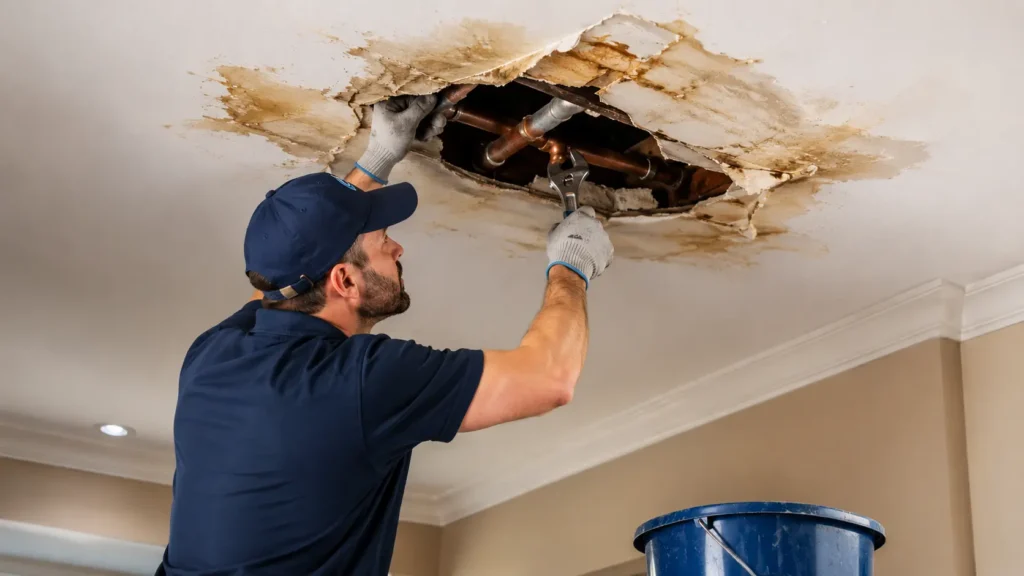
That dull brown ring spreading across your ceiling isn’t just an eyesore; it’s your house trying to tell you something. Water stains on the ceiling almost always mean water is going somewhere it shouldn’t, and in most Brampton homes, that “somewhere” is a plumbing problem hiding behind drywall, above a bathroom, or inside a wall cavity you can’t see.
The tricky part is that plumbing leaks rarely announce themselves. A pipe joint can drip for weeks before enough moisture builds up to show on the surface. By the time you notice a stain, the leak has often been active far longer than you’d think, quietly soaking insulation, weakening drywall, and creating the perfect environment for mould.
In this guide, we’ll walk through what different ceiling stains actually mean, the ten most common hidden plumbing causes we see in Brampton homes, how to tell a plumbing leak apart from a roof leak, what to do the moment you spot a stain, and how to stop it from happening again. Whether you’re dealing with a fresh brown patch or a stain that keeps coming back, you’ll know exactly what to look for and when it’s time to call in a professional.
What Do Water Stains on the Ceiling Mean?
Not every ceiling stain tells the same story. The colour, shape, and texture of the mark can actually help you figure out what’s going on before a plumber even walks through the door.
Fresh stains tend to look yellowish or light tan, with a soft, still-damp edge. Older stains turn a darker brown as minerals and rust from the water dry into the drywall over repeated exposure. A ring within a ring, sometimes called a “halo” pattern, usually means the leak has happened more than once, drying and re-wetting the same spot each time.
If the stain feels damp, spongy, or is actively growing, you’re likely looking at an active leak happening right now. A dry, stable stain that hasn’t changed in size for weeks may point to an old leak that was already repaired, or a slow drip that hasn’t been active recently. Either way, ceiling discoloration is a sign that hidden moisture has already made contact with your drywall, and water always spreads outward and downward along the path of least resistance, which is why a leak above your bathroom might show up on the ceiling several feet away from where the actual pipe joint failed.
Did You Know? A leak dripping just one drop of water per second can waste over 3,000 gallons of water a year, enough to fill a small swimming pool, and more than enough to soak through drywall and framing long before you ever see a stain.
10 Hidden Plumbing Causes of Ceiling Water Stains
Ceiling stains almost always trace back to a plumbing leak somewhere above or beside the affected area. Here are the ten causes we run into most often in Brampton homes, from older properties in older neighbourhoods to newer builds with tightly packed mechanical systems.
1. Hidden Water Supply Pipe Leaks
Supply lines run under constant water pressure, which means even a pinhole leak can push out a steady stream of water 24 hours a day. Over time, corrosion, a loose fitting, or a small crack in copper or PEX piping lets water escape into the ceiling cavity below.
- Why it stains the ceiling: Because these pipes carry pressurized water, leaks tend to be continuous rather than occasional, soaking the same spot repeatedly until it shows through.
- Warning signs: A stain that keeps growing, a hissing sound inside the wall, or an unexplained jump in your water bill.
- Can you inspect it yourself? You can check exposed pipes in a basement or crawlspace for corrosion, moisture, or mineral buildup around fittings, but pipes hidden inside finished walls and ceilings aren’t something you can safely inspect on your own.
- When to call a plumber: As soon as you notice a stain paired with a pressure drop or rising water bill, pressurized leaks rarely fix themselves and tend to get worse.
- Prevention tip: Have your home’s water pressure tested periodically. Consistently high pressure puts extra strain on every joint and fitting in your system.
2. Drain Pipe Leaks
Unlike supply lines, drain pipes aren’t pressurized; they only carry water when something is being used, like a sink or shower. Leaks here often come from a cracked pipe, a failed seal at a joint, or a clog that’s forcing wastewater to back up and escape somewhere it shouldn’t.
- Why it stains the ceiling: Because drain leaks are tied to usage, the stain often appears or worsens right after someone runs the sink, flushes the toilet, or takes a shower upstairs.
- Warning signs: A stain that seems to appear after specific plumbing use, or a faint sewer-like smell near the affected area.
- Can you inspect it yourself? You can watch the ceiling while someone runs the fixture above to see if the stain darkens in real time; that’s a strong clue pointing to a drain pipe leak.
- When to call a plumber: If you notice any odour along with the stain, since that can indicate wastewater rather than clean supply water.
- Prevention tip: Avoid pouring grease or flushing wipes, as clogs put extra strain on drain pipe joints over time. Provide drain cleaning for prevention.
3. Shower or Bathtub Plumbing Leaks
The plumbing behind a shower or tub, including the valve, showerhead connection, and drain assembly, sits inside a wall or floor cavity that’s exposed to water every single day. A failed seal or worn gasket here is one of the most common causes of a bathroom plumbing leak.
- Why it stains the ceiling: If the shower is on an upper floor, water seeping past the tile or a failed drain seal travels straight down into the ceiling below.
- Warning signs: Loose or discoloured grout, a soft-feeling floor near the tub, or a stain directly beneath the shower area.
- Can you inspect it yourself? You can check the caulking and grout around the tub or shower for cracks, but the plumbing behind the wall requires a professional to access safely.
- When to call a plumber: If the stain sits directly under a bathroom and grows after each shower.
- Prevention tip: Reseal grout and caulking annually, since worn caulking is one of the easiest entry points for water.
4. Upstairs Toilet Leaks
A toilet on an upper floor connects to both a water supply line and a wax ring seal at its base. Either one failing can send water downward through the wax ring, especially since a worn seal lets water seep out with every flush.
- Why it stains the ceiling: Toilets get used constantly, so even a small leak at the base adds up quickly, often creating a stain almost directly beneath the toilet on the floor below.
- Warning signs: A stain in the ceiling that lines up with the bathroom above, a rocking or unstable toilet, or a musty smell near the base.
- Can you inspect it yourself? Yes, check if the toilet rocks side to side, and look for water pooling around its base after flushing.
- When to call a plumber: If the toilet feels loose or you see water at the base, since a failed wax ring needs to be replaced before it causes more damage.
- Prevention tip: Have the toilet reseated whenever it feels unstable rather than waiting for visible leaking.
5. Water Heater Pipe Leaks
If your water heater sits above the main living space, common in some Brampton townhomes and condos, the pipes feeding into and out of the tank can develop leaks at connection points, valves, or the tank itself as it ages.
- Why it stains the ceiling: These leaks are often slow and continuous, since the tank is connected to your home’s water supply around the clock.
- Warning signs: A stain near or below a mechanical room, rust-coloured water, or a water heater older than 10 years.
- Can you inspect it yourself? You can visually check the water heater for pooling water, rust, or corrosion at the fittings.
- When to call a plumber: If you see any moisture around the tank or fittings, since an aging water heater can fail suddenly.
- Prevention tip: Have your water heater inspected annually, especially once it passes the eight to ten year mark.
6. Washing Machine Hose Leaks
The rubber or braided hoses connecting your washing machine to the water supply line are under constant pressure whenever the machine isn’t running, and take repeated pressure surges every time it fills.
- Why it stains the ceiling: If your laundry room is upstairs, a burst or leaking hose can send water straight down through the floor and into the ceiling below.
- Warning signs: A stain beneath a laundry room, or dampness around the washing machine connections.
- Can you inspect it yourself? Yes, check the hoses for bulging, cracking, or moisture, especially if they haven’t been replaced in several years.
- When to call a plumber: If the hose is worn, or if you notice a stain forming below your laundry area.
- Prevention tip: Replace washing machine hoses every five years, even if they look fine, and consider upgrading to braided stainless steel hoses.
7. Refrigerator Water Line Leaks
If your fridge has an ice maker or water dispenser located on an upper floor, it’s connected to a thin plastic or copper line that’s easy to kink, puncture, or wear out over time.
- Why it stains the ceiling: These lines run slowly but constantly, so a small leak can drip unnoticed behind or under the fridge for a long time before it’s caught.
- Warning signs: A stain below the kitchen, or a puddle you keep noticing near the base of the fridge.
- Can you inspect it yourself? Yes, pull the fridge out carefully and check the water line for kinks, cracks, or moisture.
- When to call a plumber: If the line looks damaged or if the stain keeps reappearing below the kitchen.
- Prevention tip: Inspect the water line whenever you clean behind the fridge, and replace plastic lines with more durable copper or braided options.
8. Faulty Plumbing Joints
Every pipe joint in your home is a potential weak point. Over time, soldered joints, compression fittings, and glued connections can loosen from temperature changes, water pressure, or simple age.
- Why it stains the ceiling: A joint doesn’t need to fail to cause damage; even a slow, steady drip at a single connection point is enough to create a stain over weeks or months.
- Warning signs: A stain that appears gradually rather than suddenly, often in a spot that doesn’t correspond to an obvious fixture above.
- Can you inspect it yourself? Only for joints you can physically see and access, such as under a sink or in a basement ceiling.
- When to call a plumber: If you can’t identify an obvious source above the stain, it likely means the leak is coming from a joint hidden inside a wall or ceiling cavity.
- Prevention tip: Have your home’s exposed plumbing services inspected every couple of years, particularly if your home is older or has had recent renovation work.
9. Hidden Leaks Inside Walls
Sometimes a leak doesn’t originate directly above the stain at all. Water can travel along a wall stud, follow a pipe run, or seep along the underside of subflooring before finally showing up somewhere unexpected.
- Why it stains the ceiling: Because water follows gravity and the path of least resistance, a leak several feet away can still end up pooling and staining a ceiling that seems unrelated at first glance.
- Warning signs: Stains that don’t line up with any bathroom, kitchen, or laundry area above, or multiple small stains appearing along the same wall line.
- Can you inspect it yourself? Not safely tracing a hidden leak inside a wall usually requires moisture meters or thermal imaging equipment.
- When to call a plumber: Any time the source of a stain isn’t obvious, since guessing and cutting into drywall without proper leak detection tools often causes unnecessary damage.
- Prevention tip: If a stain’s location doesn’t make sense, don’t wait; professional water leak detection can pinpoint the exact source without tearing your home apart.
10. Ignoring Small Plumbing Leaks
This last cause isn’t a specific pipe or fixture; it’s a pattern we see constantly. A small drip gets noticed, dismissed as “not that bad,” and left alone. Weeks or months later, that same small leak has turned into a much bigger repair.
- Why it stains the ceiling: Even minor leaks are cumulative. Water doesn’t evaporate from inside a ceiling cavity the way it does on an exposed surface, so moisture just keeps building.
- Warning signs: A stain that was small and stable suddenly starts spreading, darkening, or sagging.
- Can you inspect it yourself? You can monitor a known small leak, but monitoring isn’t the same as fixing it.
- When to call a plumber: Right away. The earlier a small leak is addressed, the less it costs to repair and the less damage it causes to drywall, insulation, and framing.
- Prevention tip: Treat every leak as urgent, no matter how minor it looks. A twenty-dollar fitting today is far cheaper than a ceiling repair down the road.
Plumbing Leak or Roof Leak?
Not every ceiling stain comes from a pipe. Roof leaks can look similar at first glance, so here’s how to tell the difference.
| Factor | Plumbing Leak | Roof Leak |
| Timing | Can appear any time, regardless of weather | Usually appears during or right after rain or snowmelt |
| Stain Location | Often near bathrooms, kitchens, or laundry areas | Often near exterior walls, attic access points, or roof valleys |
| Water Meter Movement | Meter keeps moving even with all fixtures off | No connection to water meter activity |
| Water Bill | May increase noticeably | Typically stays normal |
| Weather Pattern | Not weather-dependent | Directly tied to rain, snow, or ice buildup |
| Warning Signs | Stain near plumbing fixtures, possible odour | Stain near roofline, may worsen with storms |
| Repair Method | Requires a licensed plumber | Requires a roofing contractor |
What To Do Immediately
If you’ve just spotted a water stain, here’s what to do before it gets worse.
- Stop using nearby plumbing. If the stain is below a bathroom or kitchen, avoid running that sink, shower, or toilet until you know the source.
- Inspect safely. Look at the stain from a distance first; don’t poke or press on sagging drywall, as it can collapse.
- Photograph the damage. Take clear photos right away to track how the stain changes over the next day or two, and for insurance purposes if needed.
- Move furniture and belongings. Clear the area below the stain in case the ceiling weakens further.
- Test the water meter. Turn off every fixture in the house, then check if the meter is still moving. If it is, you likely have an active plumbing leak.
- Avoid electrical hazards. Never touch light fixtures, switches, or outlets near a wet ceiling, and shut off power to that area if you can do so safely.
- Know when to call a plumber. If the stain is spreading, the ceiling feels soft, or the water meter confirms an active leak, it’s time to bring in a professional.
Warning: A sagging or bulging ceiling can collapse with little warning. If you notice bulging drywall, sagging, or dripping water, stay out of the room, keep others away, and contact a plumber immediately.
When Should You Call a Professional Plumber?
Some ceiling stains are worth watching for a day or two. Others need attention right away. Call a professional plumber if you notice:
- A stain that keeps growing in size or getting darker
- Sagging, bulging, or soft drywall
- Visible mould or a musty smell
- The same stain reappearing after it seemed to dry
- Active dripping, even if it’s slow
- Soft, spongy drywall when gently touched
- A water bill that’s higher than usual with no clear reason
- A stain with no obvious source above it
Any one of these on its own is worth a call. Together, they usually mean a hidden plumbing leak has been active for a while and needs proper leak detection to find and fix.
Tip: Always hire a licensed plumbing contractor for repairs involving hidden leaks or water damage. Licensed professionals meet the City of Brampton’s requirements and help ensure the work is completed safely and in compliance with local regulations. You can verify licensing requirements through the City of Brampton Plumbing Contractor Licensing Requirements.
How To Prevent Ceiling Water Damage
- Check under sinks, around toilets, and near appliances every few months for early signs of moisture.
- Replace washing machine and fridge water lines every five years, even if they look fine.
- Keep an eye on your water bill for unexplained increases.
- Reseal bathroom caulking and grout annually.
- Have your water heater inspected once a year, especially after it passes eight years old.
- Don’t ignore small, slow drips; they’re often the first sign of a bigger problem forming.
- Schedule a plumbing inspection every couple of years, particularly for older Brampton homes.
- Know where your main water shutoff valve is so you can act fast if a leak turns serious.
Frequently Asked Questions
1. Can a ceiling water stain go away on its own?
The visible stain might fade slightly as it dries, but the underlying cause won’t fix itself. If a plumbing leak caused it, the source needs to be repaired, or it will come back.
2. Is a brown water stain on the ceiling dangerous?
It can be. Beyond structural damage to drywall, prolonged moisture creates ideal conditions for mould growth, which can affect indoor air quality.
3. How do I know if my ceiling stain is from plumbing or a roof leak?
Check the timing. Stains tied to rain or snow usually point to a roof leak, while stains that appear regardless of weather often trace back to a plumbing leak.
4. Can I just paint over a ceiling water stain?
You can, but painting over a stain without fixing the source only hides the problem. The leak will likely resurface, and the stain will bleed through the new paint.
5. How much does ceiling leak repair cost in Brampton?
Costs vary depending on the source of the leak, how much drywall needs replacing, and whether the plumbing itself needs repair. A plumber in Brampton can give you an accurate estimate after inspecting the leak.
6. What does a fresh water stain look like compared to an old one?
Fresh stains tend to be lighter and may still feel damp, while older stains are usually darker brown with a defined ring or edge from repeated drying.
7. Can hidden pipe leaks cause mould without any visible stain?
Yes. Mould can develop inside a wall or ceiling cavity before moisture ever becomes visible on the surface, which is why odour and air quality changes matter too.
8. Should I turn off my water if I see a ceiling stain?
If the stain is actively dripping or growing quickly, turning off the water supply to the affected fixture or the main shutoff if you’re unsure of the source is a smart precaution while you wait for a plumber.
Conclusion
Water stains on the ceiling are never just a cosmetic issue; they’re a signal that water is somewhere it shouldn’t be, and in most Brampton homes, that means a hidden plumbing leak is at work. From supply pipes and drain lines to toilets, water heaters, and appliance hoses, there are plenty of hidden sources that can turn a small drip into serious ceiling water damage if left unchecked.
The good news is that most of these problems are manageable when caught early. Keep an eye on your water bill, check your fixtures regularly, and never ignore a stain that’s growing, darkening, or reappearing. When in doubt, professional leak detection takes the guesswork out of the equation and stops small leaks from becoming major repairs.
If you’ve spotted water stains on your ceiling and aren’t sure what’s causing them, the team at Drain Experts Plumbing is ready to help. We serve homeowners throughout Brampton with fast, accurate leak detection and reliable plumbing repairs. Get in touch today, and let’s find the source before it gets worse.