

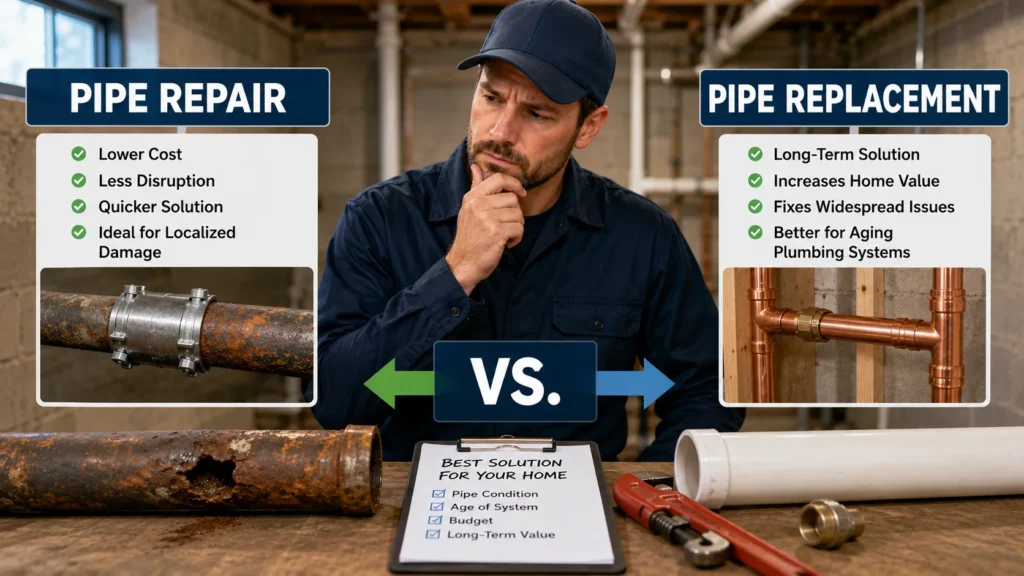
Every Brampton homeowner eventually asks the same question: is this pipe worth fixing, or is it time to replace it? It usually comes up at the worst moment: a slow leak under the kitchen sink, a rusty spot on the basement ceiling, or a plumber standing in your driveway with a camera and a quote you weren’t expecting.
Repair and replacement aren’t two prices on the same problem; they’re different solutions, and picking the wrong one can cost you twice: once for the fix that doesn’t hold, and again for the replacement you end up needing anyway. Waiting rarely helps, either. A pinhole leak that costs a few hundred dollars to patch today can turn into a drywall, flooring, and mould remediation bill if it’s left to seep behind a wall for another year.
Brampton’s climate adds its own wrinkle. Our freeze-thaw cycles put real stress on pipes, especially in homes built before the 1980s where galvanized steel or older cast iron is still in place. A century home downtown, a 1990s subdivision house, and a newer build can each have very different Full Plumbing Service needs, even when the symptom a leak, a clog, low pressure looks the same on the surface.
This Pipe Repair vs. Pipe Replacement in Brampton guide walks through how plumbers actually make the repair-or-replace call, what signs point to each option, and how to avoid paying for a full repipe when a targeted repair would do the job or for repeated repairs when replacement was the smarter move all along.
Understanding the Difference Between Pipe Repair vs. Pipe Replacement in Brampton
Before comparing signs and scenarios, it helps to know what each option actually involves; they aren’t interchangeable terms, and they solve different kinds of problems.
What Pipe Repair Includes
Pipe repair is a targeted fix: a plumber addresses a specific, isolated problem without touching the rest of the system. Typical work includes sealing or replacing a cracked joint, patching a small localized leak, cutting out a short corroded section, tightening a loose fitting, or clearing minor root intrusion from a single point in a drain line.
Repair is faster, less invasive, and less expensive than replacement, and it doesn’t require opening large sections of wall, floor, or yard. But it only works when the surrounding pipe is still structurally sound. Patch one leak on a pipe that’s corroded throughout, and you’re likely back in the same spot within a year, just a few feet down the line.
What Pipe Replacement Includes
Pipe replacement targets pipes failing as a system rather than at a single point. This can mean partial replacement of a section showing widespread wear, full repiping of a home’s supply lines, underground pipe replacement, or a full sewer line repair between the home and the municipal connection.
Replacement is a bigger investment upfront, but it resets the clock instead of managing an aging system one leak at a time; you get a plumbing network with a full remaining lifespan. The trade-off is disruption, which can mean excavation, drywall work, or time without water to certain fixtures, depending on scope.
Neither option is inherently “better.” The right call depends on the pipe’s condition, age, material, and how often problems have already occurred, which is what the signs below help you evaluate.
8 Signs Your Pipes Can Still Be Repaired
If your plumbing is showing one of these patterns, there’s a good chance a repair, not a full replacement, will solve the problem.
1. Small, Localized Leaks
A single drip at a joint, rather than seepage along the pipe’s length, usually points to a worn washer or loose connection. Homeowners tend to ignore these, but left alone, they can warp subflooring or feed hidden mould. If the rest of the pipe looks sound, this is usually a one-visit fix.
2. Minor Corrosion
Greenish staining on copper or light rust on steel fittings doesn’t automatically mean the whole pipe is compromised. Plumbers assess depth and spread when corrosion is limited to a fitting or short section; cutting it out is often enough.
3. One Recurring Leak (Not Several)
A leak that keeps returning to the same spot usually means the fitting needs replacing, not that the whole run has failed. That’s different from leaks in several unrelated locations, a red flag covered below.
4. Slightly Reduced Water Pressure
A mild, gradual drop at one fixture often comes from mineral buildup or a partially closed valve rather than pipe failure. If it’s isolated to one tap, an inspection can usually pinpoint a simple, fixable cause.
5. Small Root Intrusion
Tree roots seeking moisture can work into a small crack or loose joint in a drain line. Caught early, this is a repair clear the roots and seals the opening. It only becomes a replacement issue once cracking is widespread.
6. One Damaged Section
If a camera inspection shows the rest of the run is solid and damage is confined to a short stretch, say, nicked during a renovation, replacing just that piece is the most cost-effective route.
7. Loose Fittings
Fittings can loosen over time from thermal expansion, especially through Brampton’s seasonal swings. A loose fitting causing a drip or whistle is a simple tightening job, not a sign of system-wide failure.
8. Early Pipe Wear
Pipes approaching middle age for their material, but still structurally intact, often just need monitoring. An inspection tells you whether you’re looking at manageable early wear or the start of a worsening pattern.
When to call a professional: any time a leak returns, corrosion looks deeper than surface level, or you’re unsure whether what you’re seeing is isolated.
8 Signs Pipe Replacement Is the Better Long-Term Solution
Some situations move past what a repair can reasonably fix. Here’s when replacement becomes the more cost-effective long-term choice.
1. Frequent Leaks
When leaks show up every few months, even in different spots, it’s a sign the pipe material itself is breaking down, not bad luck. Each repair becomes a temporary patch on a system that’s failing as a whole.
2. Multiple Repairs Every Year
If you’re calling a plumber for the same plumbing system more than once or twice a year, the cumulative cost of those visits often exceeds what replacement would have cost. It’s a financial signal homeowners tend to underestimate.
3. Severe Corrosion
Corrosion that’s eaten through a significant portion of a pipe’s wall thickness, or that shows up at multiple points along a run, isn’t something a spot repair can solve; the pipe has lost structural integrity broadly, not just at one trouble spot.
4. Water Discoloration
Persistent brown or rust-coloured water, especially if it doesn’t clear after running the tap, often indicates internal corrosion throughout galvanized or older iron piping. That’s a system-wide symptom, not a single-point problem.
5. Major Root Intrusion
When roots have infiltrated a pipe extensively, or repeated root clearing hasn’t stopped backups from returning, the pipe’s structure is usually compromised enough that replacement, often using trenchless pipe repair methods, is the more durable fix.
6. Collapsed Sewer Pipes
A fully or partially collapsed section of sewer line can’t be patched. Depending on severity, this typically calls for replacing that section or, in more serious cases, the full underground run.
7. Widespread Pipe Deterioration
A camera inspection revealing deterioration along the entire length of a pipe, rather than at one identifiable point, signals that repair would only delay the inevitable at a higher total cost.
8. Repeated Emergency Plumbing Issues
Needing emergency plumbing service more than once for pipe failures is meaningful data on its own. Emergency visits cost more than scheduled work, and repeated emergencies usually mean the system needs a permanent fix.
In each case, replacement becomes more cost-effective not because it’s cheaper upfront, but because it stops the ongoing cycle of service calls, water damage risk, and rising utility bills.
Pipe Repair vs. Pipe Replacement: Side-by-Side Comparison
| Factor | Pipe Repair | Pipe Replacement |
| Cost factors | Lower upfront cost; cost can add up if repairs recur | Higher upfront investment; resets ongoing repair costs |
| Lifespan | Extends life of an otherwise sound pipe | Provides a full new lifespan for the material used |
| Repair time | Usually completed in one visit | Can range from a day to several days depending on scope |
| Long-term value | Best when damage is isolated | Better value when damage is widespread or recurring |
| Property disruption | Minimal; often no excavation needed | Can involve excavation, drywall, or flooring work |
| Future maintenance | May need repeat repairs if underlying pipe is aging | Lower near-term maintenance needs |
| Best use cases | Single leaks, isolated corrosion, loose fittings | Frequent failures, severe corrosion, collapsed sections |
How Camera Inspections Help Plumbers Make the Right Decision
You can’t make a sound repair-or-replace decision based on guesswork, and most pipe problems happen somewhere you can’t see inside a wall, under a slab, or several feet underground. That’s where camera inspections change the equation.
A plumbing camera inspection feeds a small, waterproof camera through the pipe to record its interior condition in real time. Instead of relying on surface symptoms a damp spot, a slow drain, a pressure drop the plumber can see exactly what’s happening: whether a leak is a pinhole or a spreading crack, how far root intrusion has spread, whether corrosion has eaten through the pipe wall, and whether a section has partially collapsed.
This diagnostic step prevents two costly mistakes: unnecessary excavation to fix a problem that turns out to be a single bad fitting, and repairing a visible symptom while the real damage sits further down the line, out of sight, guaranteeing a return visit within months.
Common Pipe Materials Found in Brampton Homes
The material your pipes are made from has a big impact on how long they last, what tends to go wrong, and whether repair or replacement makes more sense.
- Copper: Durable, lasting 50 years or more, and highly repairable; a corroded or pinholed section can usually be cut out and replaced. Its main vulnerability is pitting corrosion in homes with more acidic water.
- PEX: A flexible plastic common in newer builds. It resists corrosion, handles freeze-thaw stress well, and is easy to repair at a specific fitting. Problems are usually tied to fitting quality rather than the pipe itself.
- PVC: Used for drain, waste, and vent lines rather than pressurized supply. It resists corrosion and root intrusion better than older clay or cast iron, though joints can fail over time and are generally easy to repair.
- ABS: Similar in use to PVC, this rigid black plastic is common in drain lines from the 1970s onward. It’s durable but can become brittle with age, at which point replacing the affected run may be recommended.
- Cast Iron: Common in older Brampton homes for main drain and sewer lines. It’s heavy and durable but corrodes from the inside over decades. Early corrosion can sometimes be managed, but widespread deterioration usually calls for replacement, often via trenchless methods.
- Galvanized Steel: Typically found in much older homes. Its zinc coating wears away internally, a frequent cause of discoloured water and reduced pressure. It has the shortest practical lifespan here, and corrosion tends to be widespread rather than isolated, making replacement the more common recommendation as these systems age.
What Factors Affect the Cost of Pipe Repair or Replacement?
Several factors consistently influence how much a repair or replacement job costs, without any fixed pricing involved:
- Accessibility: A pipe behind an open basement wall is far less expensive to reach than one under a finished floor or several feet underground.
- Pipe location: Interior supply lines are typically more straightforward than underground water or sewer lines, which may involve excavation.
- Material: Some materials are quicker and less labour-intensive to cut, join, and seal than others.
- Extent of damage: A single fitting repair costs a fraction of a multi-section replacement.
- Emergency repairs: After-hours or urgent service typically costs more than scheduled work.
- Hidden water damage: If a leak has already damaged drywall, flooring, or subfloor, remediation adds to the total cost.
- Permits: Larger replacement projects involving underground work may require permits depending on the scope; your municipality’s building department is the authority on what applies to your project.
Why Delaying Pipe Repairs Can Become More Expensive
It’s tempting to put off a small leak, especially when it seems more like an inconvenience than an emergency. But plumbing problems rarely stay small on their own timeline.
A slow leak inside a wall doesn’t just waste water; it creates the damp, dark conditions mould needs to establish itself, often before any visible staining appears. Left long enough, that moisture can weaken subflooring, drywall, and in severe cases, structural framing, turning what would have been a same-day repair into a renovation project.
The financial cost builds quietly too. A hairline crack that widens over months means a slowly climbing water bill before anyone notices a puddle, and corrosion is progressive; a small compromised section today is the seed of a wider failure next year. Homeowners can also review the Region of Peel’s homeowner information on sewer systems and maintenance responsibilities to better understand how private plumbing connects to municipal infrastructure and what property owners are responsible for maintaining.
A homeowner who notices a small, intermittent damp patch near a basement floor drain and assumes it’s condensation may find, months later, that it was a slow leak feeding water into the subfloor the whole time, turning a straightforward repair into a job that now includes flooring replacement.
Why a Professional Plumbing Inspection Should Always Come First
A visual check from the outside only tells part of the story. You can see a damp spot on a ceiling or notice pressure has dropped, but you can’t see what’s happening inside the pipe, behind the wall, or below the ground, and guessing at that stage tends to lead to the wrong fix.
A professional plumbing inspection changes the outcome. Camera inspections, pressure testing, and a trained eye for how different materials fail let a plumber diagnose the actual cause rather than treating a symptom, preventing both a full replacement when a targeted repair would have worked, and a repair that doesn’t address a deeper issue and fails again within months.
If you’re not sure whether what you’re dealing with is a one-time issue or a bigger problem, that uncertainty is usually reason enough to book an inspection, and it’s the same process our team uses on every pipe repair Brampton and pipe replacement Brampton call before recommending a course of action.
Frequently Asked Questions
Can old pipes always be repaired?
Not always. Age alone doesn’t rule out repair, but older pipes are more likely to have widespread wear rather than one isolated problem. A camera inspection helps determine whether an older pipe has a single fixable issue or deterioration spread across the whole run, which would favour replacement instead.
How do plumbers decide Pipe Repair vs. Pipe Replacement in Brampton?
Plumbers assess the extent of damage, the pipe’s material and age, how often problems have recurred, and results from diagnostics like camera inspections. Isolated damage on an otherwise sound pipe usually means repair; widespread deterioration or repeated failures generally point to replacement.
How long do different pipe materials last?
Lifespan varies by material and water conditions. Copper and PEX often last 50 years or more, PVC and ABS drain lines can last several decades, cast iron typically lasts 50 to 100 years, and galvanized steel usually has the shortest lifespan, often needing replacement within 40 to 50 years.
Are camera inspections worth it?
Yes, particularly for underground or hidden plumbing. They show the actual internal condition of a pipe instead of relying on surface symptoms, helping avoid both unnecessary excavation and repairs that miss the real source of a problem. The diagnostic cost is usually far lower than the cost of guessing wrong.
Can frozen pipes be repaired?
Often, yes, if a frozen pipe hasn’t cracked, thawing it safely typically resolves the issue. If freezing caused a split, that section will need repair or replacement. Preventing freezing in the first place, through insulation and steady indoor temperatures, is the more cost-effective approach during Brampton winters.
Should I replace pipes before renovating?
If you’re already opening walls or floors, it’s worth having aging pipes inspected first. Replacing pipes while the space is open is significantly less disruptive and often less costly than doing it as a separate project later.
What causes underground pipe damage?
Common causes include tree root intrusion, soil shifting, ground freezing and thawing, pipe age, and physical damage from nearby excavation. Underground pipes are also harder to monitor, so problems are often more advanced by the time they’re noticed.
How often should pipes be inspected?
For most homes, a general inspection every couple of years is reasonable, with more frequent checks for older homes or those with recurring issues. Homes with mature trees near sewer lines may also benefit from periodic camera inspections to catch root intrusion early.
Conclusion
There’s no single answer to pipe repair vs. pipe replacement in Brampton; every home, every plumbing system has its own age, material, and history. Often, a timely, well-diagnosed repair is all that’s needed, especially when a problem is caught early and stays isolated. In other cases, particularly with corrosion, recurring leaks, or collapsed sections, replacement is genuinely the smarter long-term investment.
What consistently makes the difference is diagnosis before decision. A professional inspection, backed by camera technology where needed, gives you a clear picture of what’s actually happening in your pipes instead of a guess based on visible symptoms.
If you’re dealing with a leak, discoloured water, reduced pressure, or you’re simply unsure what condition your home’s plumbing is in, contact us to schedule an inspection with a trusted plumber in Brampton. We’ll give you a straight answer on whether repair or replacement is right for your home and why.