

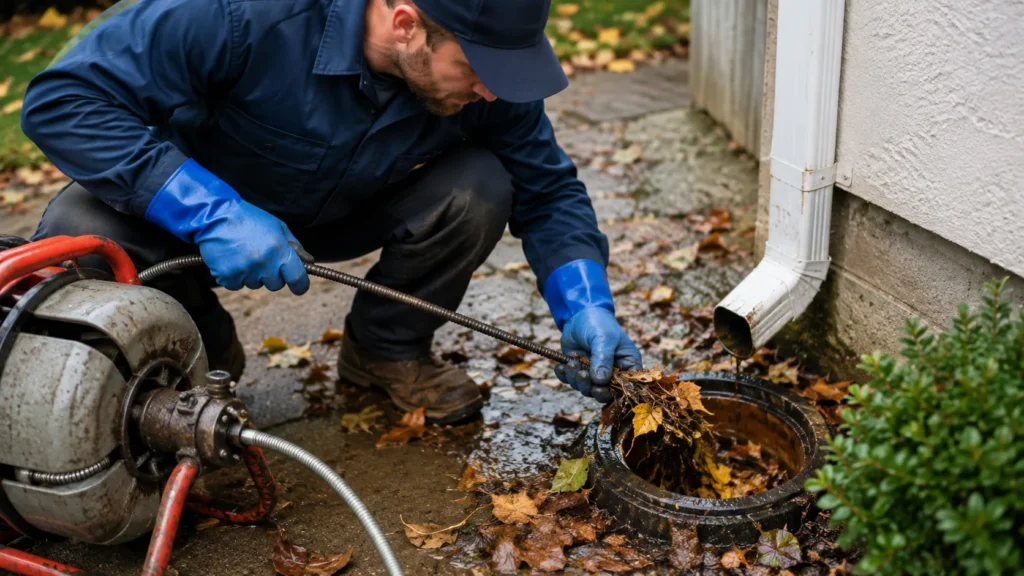
There’s a particular sound every Toronto homeowner knows in late September: the scrape of a rake against pavement, followed by the soft thud of a full leaf bag hitting the curb. Fall brings crisp mornings, colourful trees, and a noticeable uptick in outdoor cleanup. Most homeowners focus on clearing gutters, sealing windows, and getting the furnace serviced before winter. Drains, however, often get overlooked until water starts pooling somewhere it shouldn’t.
So, can fall leaves clog drains? Yes, accumulated leaves can contribute to drain blockages, especially when they mix with dirt, twigs, mud, and other debris that collects on driveways, walkways, and lawns throughout October and November. It’s rarely a single leaf causing the problem. It’s the buildup over weeks of wind, rain, and neglected drain grates. Understanding how this happens and what to do about it can save you from a soggy backyard or a slow basement drain later in the season.
Can Fall Leaves Clog Drains?
The short answer is yes, but the full picture is a bit more nuanced. There’s a real difference between a few leaves resting on top of a drain grate and a drainage system that’s actually restricted or blocked.
Leaves sitting loosely on a grate usually just need to be swept away. The water underneath can often still find its way through the gaps. The concern grows when leaves start piling up in layers, especially after rain, because that’s when they begin to mat together and restrict how much water can pass through. From there, some organic material can work its way past the grate and into the drainage system itself, where it joins sediment, twigs, and other debris already sitting inside the pipe or catch basin.
A few leaves on a drain grate do not automatically mean the drain is clogged. The real concern is restricted water flow or debris accumulating within the drainage system over time. It’s also worth remembering that not every drainage issue in fall is leaf-related; sometimes leaves are simply the most visible symptom of a problem that already existed.
Which Drains Are Most Likely to Be Affected by Fall Leaves?
Not all drains on a property face the same risk. Some are far more exposed to falling leaves than others.
Yard and Outdoor Drains
Ground-level drains in backyards, side yards, and low points in the lawn are prime collection spots. Wind naturally pushes leaves toward these low areas, and if nobody’s checking them regularly, they can quietly build up over several weeks.
Catch Basins
Catch basins are designed to collect surface water before it moves into the broader drainage system, but that same design means they also collect leaves, sediment, and other debris. Over a fall season, a catch basin can accumulate a surprising amount of material if it isn’t inspected periodically.
Downspout Drains
Downspouts move water away from the roofline, but the outlets where they connect to underground drainage lines can become obstructed by leaves that wash down from the gutters above or accumulate around the base of the downspout itself.
Basement and Foundation Drainage
Exterior drainage around a home’s foundation is meant to direct water away from the basement walls. When that drainage becomes restricted by leaves and debris, water can linger near the foundation longer than it should, which is a concern for older homes throughout Toronto with aging weeping tile or foundation drainage systems.
Stormwater Drainage Points
Municipal and property-level stormwater drainage points need to stay clear, particularly during Toronto’s heavier fall rain events. A blocked or partially blocked drainage point can slow how quickly water is carried away from a property during a downpour.
It’s worth repeating that leaves aren’t responsible for every drainage problem on every property. They’re one factor among several, and the drains listed above are simply the ones most exposed to seasonal leaf fall.
Why Fall Leaves Become a Bigger Drain Problem When They Get Wet
Dry leaves are relatively easy to deal with. A quick pass with a rake or leaf blower usually clears them without much effort. Wet leaves are a different story.
The process tends to follow a predictable pattern: leaves accumulate on a surface, rain or dew makes them wet, and wet leaves start to compact under their own weight. As more debris, dirt, twigs, and seed pods mix in, the whole mass becomes denser and heavier. That compacted layer can form a stubborn mat directly over a drain grate, and unlike dry leaves, it doesn’t blow away or get cleared with a light sweep. It often needs to be physically lifted and removed.
This is one reason drainage issues tend to show up more in mid-to-late fall rather than right when leaves first start falling. It takes a few cycles of rain and accumulation before the problem becomes noticeable.
7 Signs Fall Leaves May Be Affecting Your Drainage
- Water pools around an outdoor drain: If water sits and doesn’t drain away within a reasonable time after rain, something is restricting flow at or near the surface.
- Water drains unusually slowly: A drain that used to clear quickly but now takes noticeably longer is worth a closer look.
- Leaves repeatedly collect around the same drain: Certain low points or wind-exposed areas will keep attracting leaves throughout the season, requiring more frequent attention.
- A catch basin appears full of debris: If you can see leaves, sediment, or standing organic matter when you check a catch basin, it’s likely restricting normal water flow.
- A downspout is not draining properly: Water spilling over the top of a downspout or pooling at its base can indicate a blockage at the outlet.
- Water backs up during heavy rainfall: Backups that only happen during or right after a storm often point to a drainage path that can’t keep up with the volume, sometimes due to debris buildup.
- Drainage remains poor after visible debris has been removed: If clearing the leaves doesn’t improve the situation, the blockage may be deeper than what leaves alone would cause.
How Toronto Homeowners Can Prevent Fall Leaf Drain Blockages
Prevention here doesn’t require special equipment; it mostly comes down to consistency.
1. Clear leaves from drain grates regularly
A single cleanup in October won’t be enough for most properties. Checking drain grates every week or two throughout fall, especially after windy days, keeps debris from building into a dense mat.
2. Keep downspout outlets clear
Water needs a direct, unobstructed path away from the foundation. Check where downspouts connect to underground drainage and clear away any leaves or debris gathering at that junction.
3. Remove twigs, mud, and nearby debris
Leaves rarely cause a blockage entirely on their own. Twigs, dirt, and mud washed off the lawn often combine with leaves to form the material that actually restricts a drain, so clearing the area around a drain matters as much as clearing the grate itself.
4. Check outdoor drains after heavy rain
A storm is a good stress test. Walk your property after significant rainfall and look for pooling water, slow drainage, or debris that’s shifted toward a drain.
5. Keep gutters and downspouts maintained
Gutters, downspouts, and ground-level drains work together as one system. Leaves left in a gutter will eventually wash down into a downspout, and from there into the drainage connected to it, so gutter maintenance is part of preventing drain issues too.
6. Never push leaves into a drain
It might seem like a quick way to tidy up, but pushing leaves into a drain simply relocates the problem underground, where it’s harder to see and harder to remove. What looks like a solved problem on the surface can turn into a more stubborn blockage later.
7. Deal with recurring drainage problems early
If the same drain keeps causing issues season after season, it’s worth addressing before winter rather than hoping it resolves on its own. Repeated backups are often a sign of an underlying issue that basic leaf removal won’t fix.
If your fall maintenance routine keeps running into the same stubborn drain, it may be time for a professional look rather than another round of DIY clearing.
Can You Remove Leaves From a Clogged Drain Yourself?
For surface-level buildup, homeowners can usually handle basic maintenance themselves:
- Remove visible leaves from the grate by hand or with a rake.
- Clear surrounding debris, including mud, twigs, and dirt near the drain opening.
- Check whether water can flow freely by pouring a small amount over the grate.
- Check an accessible downspout outlet for buildup near the connection point.
- Monitor the drain during the next rainfall to confirm the improvement holds.
If these steps restore normal drainage, that’s often all that’s needed. However, homeowners should stop DIY efforts and avoid guessing at solutions if water continues to pool, if the drain is not easily accessible, or if the blockage seems to be below the surface rather than sitting on top of the grate. Avoid pouring chemical drain cleaners into outdoor drains, attempting to access underground drainage lines, or using equipment you’re not familiar with; these steps can create bigger problems than the original blockage.
When Leaves Are Not the Real Cause of the Blockage
Sometimes a drain looks clear on the surface but continues to perform poorly, and that’s usually a sign the real issue lies deeper in the system. Persistent drainage problems can involve deeper obstructions that have built up over time, sediment that has settled inside a pipe, or tree root intrusion, which is a fairly common issue on older residential properties with mature trees near the drainage line. Damaged or collapsed sections of pipe, sewer-line blockages, and even drainage design or grading problems on the property can all produce symptoms that look similar to a leaf-related clog.
If visible leaves are removed but the drain continues to back up or drain slowly, the leaves likely aren’t the underlying cause. This is where genuine plumbing knowledge matters; distinguishing between what’s visible on the surface and what’s actually happening inside the pipe usually requires a proper inspection rather than guesswork.
When Should You Call a Plumber in Toronto for a Blocked Drain?
Some situations call for a second opinion from a professional. It’s worth reaching out to a plumber in Toronto if you notice repeated backups despite regular cleaning, if several drains on the property are affected at the same time, or if standing water keeps returning in the same spot. Water appearing in the basement, sewage odours near a drain, or gurgling sounds coming from fixtures are also signs that shouldn’t be ignored.
Problems that return shortly after you’ve cleaned a drain, or drainage issues that simply can’t be resolved by removing visible debris, usually point to something beyond routine leaf buildup. A suspected main sewer line problem in particular is not something to handle without a proper inspection.
Does Fall Leaf Buildup Mean You Need Professional Drain Cleaning?
No. Not every leaf-covered drain needs professional cleaning. In most cases, a bit of regular maintenance throughout the season is enough to keep water moving freely.
Professional drain cleaning in Toronto becomes worth considering when the blockage sits below the accessible surface, when water remains slow even after visible debris has been cleared, or when a drain repeatedly backs up despite your best efforts. It’s also a reasonable step if multiple drains are affected at once or if a property has a history of recurring drainage problems. The goal isn’t to push every homeowner toward a service call; it’s to help you recognize when basic maintenance has reached its limit.
How Drain Experts Plumbing Can Help With Recurring Drain Problems
When a drainage issue goes beyond what raking and a garden hose can fix, Drain Experts Plumbing can take a closer look and help determine what’s actually going on. A proper assessment can distinguish between surface debris that just needs clearing, a localized blockage in one section of the drain, deeper buildup that’s accumulated over time, or a more serious issue like a sewer-line obstruction or tree root intrusion. From there, the right next step, whether that’s a straightforward cleaning or a more thorough inspection, becomes much clearer. If your property has dealt with the same drainage headache more than once this season, that pattern alone is often worth having checked out before winter sets in.
Fall Drain Maintenance Checklist for Toronto Homeowners
- Clear leaves from outdoor drain grates
- Check catch basins for debris buildup
- Keep downspout outlets clear
- Remove twigs and mud near drain openings
- Check for standing water after rainfall
- Monitor for slow drainage
- Check basement drainage for signs of moisture
- Address recurring blockages before winter arrives
Frequently Asked Questions About Fall Leaves and Drain Blockages
1. Can fall leaves really clog drains?
Yes. Leaves can restrict water flow when they accumulate over drain grates or mix with mud and debris inside a drainage system. A few scattered leaves usually aren’t a concern on their own.
2. How often should I clear leaves from outdoor drains in fall?
Checking every one to two weeks is a reasonable routine for most properties, with more frequent checks after windy or rainy days when leaves collect faster.
3. Can leaves clog a basement drain?
Leaves themselves are less likely to enter a basement drain directly, but blocked exterior drainage can cause water to linger near the foundation, which may eventually affect basement drainage indirectly.
4. Should I put leaves down a drain?
No. Pushing leaves into a drain moves the problem underground, where it’s harder to detect and harder to clear.
5. What should I do if my outdoor drain is backing up?
Start by clearing visible leaves and debris from the grate and surrounding area, then monitor the drain during the next rainfall. If the backup continues, a professional assessment is a reasonable next step.
6. Can tree roots cause drain blockages in Toronto?
Yes, tree root intrusion is a known issue for older drainage systems, particularly on properties with mature trees growing near underground pipes.
7. When should I call a plumber for a blocked drain?
Call a plumber when backups are repeated, multiple drains are affected, water appears in the basement, or drainage problems continue despite regular cleaning.
8. How can professional drain cleaning help with drain blockages?
Professional cleaning can clear Drain blockages below the surface that basic homeowner maintenance can’t reach, particularly when the issue keeps returning or affects more than one drain.
Final Thoughts: Keep Fall Leaves Out of Your Drains Before They Become a Bigger Problem
Fall leaves clogging drains don’t automatically mean a drain is clogged, but left unchecked, accumulated leaves combined with mud, twigs, and other debris can genuinely restrict how well water moves off your property. The good news is that most of the prevention comes down to simple, regular habits: checking drains often, clearing visible debris, and keeping an eye on how things perform after heavy rain.
Take recurring problems seriously rather than hoping they resolve themselves, and don’t hesitate to seek professional help when basic cleaning isn’t enough. If your property has been dealing with a stubborn drain this fall, the team at Drain Experts Plumbing is a good place to start for an honest assessment before winter weather makes things harder to diagnose.